Travelers to Buddhist and Hindu countries might find a review of AUM valuable, as it exemplifies many of the fundamental tenets of these faiths.

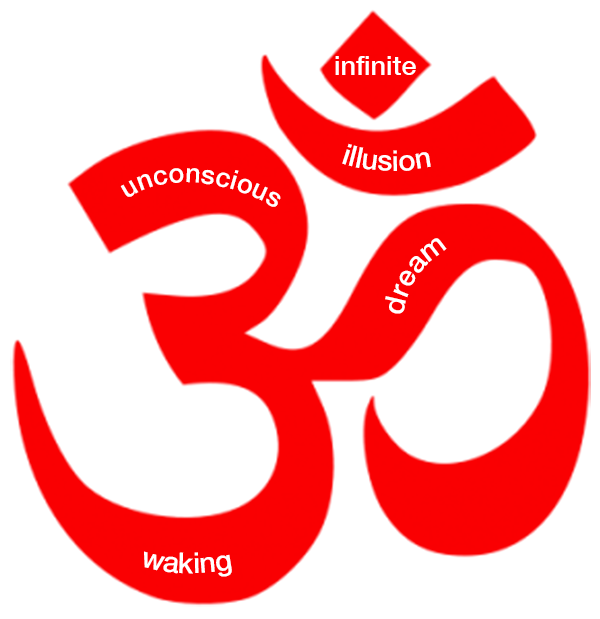
The symbol of AUM (also spelled “Om”) consists of three curves, one semicircle, and a dot; these are symbols of each person’s self and his potential:

  • The large curve (in the lower left corner of the image) symbolizes the waking state.  Perhaps it is best to think of this curve as symbolic of the ego, our outward persona, the person we think we should be, that identity that we consciously associate with the self.
  • Moving clockwise, the upper curve (upper left corner) symbolizes the unconscious state, that part of the self that is hidden to one’s consciousness, but is equally part of the self.
  • The middle curve, which extends from the center to the right side, symbolizes the dream state. This dream state, positioned vertically between the conscious and unconscious elements of the self, serves as a means to connect the two, a means for the conscious and unconscious to interact.  This is certainly what we do when we dream: the unconscious becomes conscious, affording a more complete view of the self.
  • The semicircle or crescent symbolizes illusion, specifically in this case, the illusion that the self exists as a separate entity at all.  Notice that the crescent separates the dot from the other three curves.  It is this illusion that separates the individual from becoming one with his infinite self, beyond boundaries.
  • The dot signifies the infinite, absolute self, hidden from the individual by illusion; this is what the Eastern faiths of Hinduism and Buddhism consider God.  Dispelling the illusion and becoming one with this infinite self is the ultimate experience of life and the experience of the divine.

One of our favorite descriptions of AUM, which touches on many of the symbols described above, can be found in Joseph Campbell’s book “The Hero with a Thousand Faces“.  Campbell breaks down each of AUM’s three phonemes, a, u and m:

  • The A representing the realm of waking experience: “cognitive of the hard gross facts of an outer universe, illuminated by the sun, and common to all”.
  • The U representing the realm of dream experience: “cognitive of the fluid, subtle forms of a private interior world, self-luminous and of one substance with the dreamer”.
  • The M representing the realm of deep sleep: “dreamless, profoundly beautiful” (the person unified with the unconscious and the greater self).

For Campbell, the most profound element of AUM is not the sound, however, but the silence: “The silence surrounding the syllable is the unknown: it is called simply ‘the fourth’.  The syllable itself is God as creator-preserver-destroyer, but the silence is God Eternal, absolutely uninvolved in all the openings-and-closings of the round.”

Experience the silence!

Tagged with →  

2 Responses to AUM: Symbol, Sound and Silence

  1. Andi says:

    I majored in Religious Studies in Uni (with an emphasis on the Asian religions) and we never touched upon this symbol’s true meaning. Thanks for the enlightening info. :)

Leave a Reply

Your email address will not be published. Required fields are marked *

You may use these HTML tags and attributes: <a href="" title=""> <abbr title=""> <acronym title=""> <b> <blockquote cite=""> <cite> <code> <del datetime=""> <em> <i> <q cite=""> <strike> <strong>

Share →

Get insights into the world's top cultural destinations

Tips on art, architecture, food & wine to inspire your travels.